

Stop And Identify Statutes: When Can Police Ask For Your ID?
Related Posts
In this police video, an officer knocks on a garage door. He is greeted by a man who is supposedly working on his car. The officer says that it is suspicious for the man to be working at 2 A.M. The man explains that the garage is his friend’s shop and that he has to get the car fixed to leave. The officer quickly asks the man for his ID. Baffled, the man understandably asks if the officer truly suspects he is committing a crime.
What would you do in this situation?
Police Video Analysis
No universal law allows officers to ask for your ID at any time. Rather, courts have previously ruled that officers can ask specifically if they are investigating a crime, or if they have reasonable suspicion that you are committing a crime. In the words of popular attorney, Ugo Lord, we all want law officials to be vigilant and stop crimes. At the same time, we expect them to use common sense and reason when deducing if a crime is occurring.
Presented with the facts of the situation in the video, the man in the garage could clearly explain what he was doing. All of the details of his story add up, meaning his presence leaves no room for reasonable suspicion. This is especially true under the assumption that this is not a situation with a specific burglar alarm or call to 911.
Without reasonable suspicion, the man in the video is not obligated to show the officer his ID.
When Can Police Ask For Your ID?
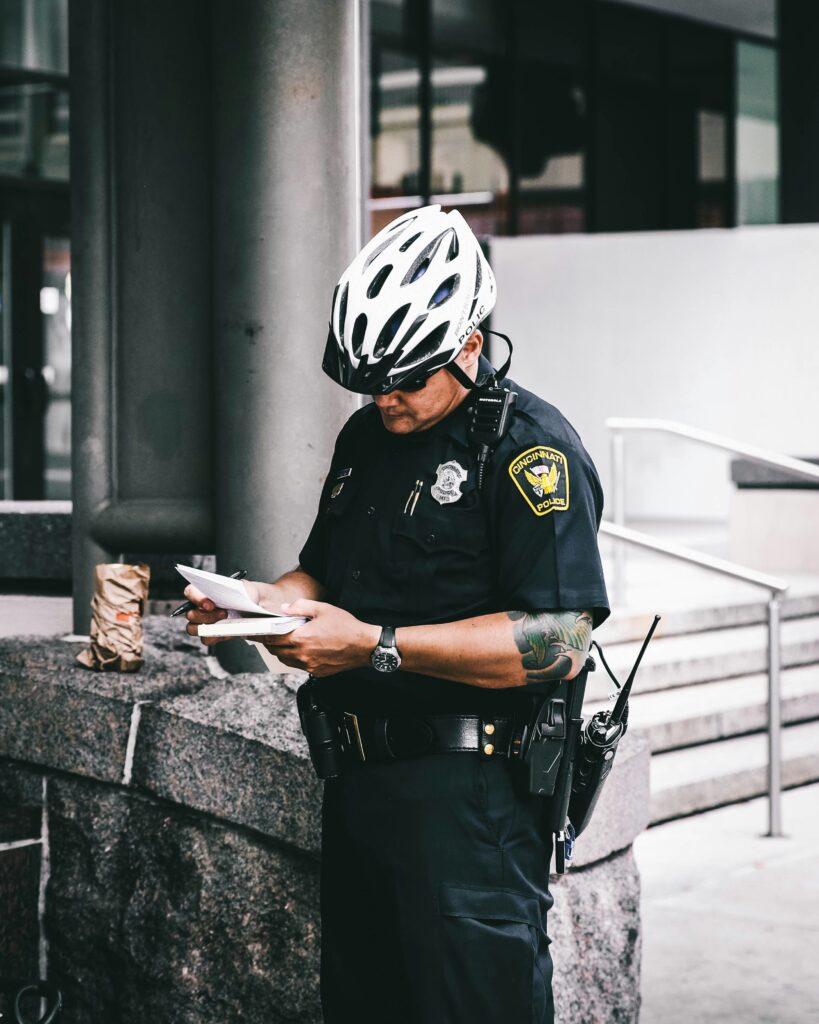
As mentioned previously, there is no universal law that allows police to ask for your ID. Generally, there need to be certain requirements for an officer to rightfully request ID.
Driving and Flying
Firstly, it is often required for people to have their ID when driving or flying in commercial aircraft. For driving, having an ID acts as proof that you are legally authorized to drive. Thus, if you are stopped by an officer while driving, you are expected to issue an ID. Failure to do so can often result in further legal complications. Similarly, having ID on flights allows law and flight officials to know you are legally flying to the proper destination.
Stop and Identify Statutes
The second instance in which police can ask for ID is if you are in a stop-and-identify statute state. Stop and identify statutes are laws that allow police to request ID if they have reasonable suspicion to suspect a crime has been or will be committed. Failure to comply with an ID request in a stop-and-identify state can result in an arrest.
As of 2024, 26 states have adopted stop and identify statutes. Each state has unique guidelines and rules within its stop-and-identify statutes. Some states require only a name and address. Others require a date of birth, and some require a written form of identification.
The state of stop and identify statutes is not well understood by most people. For more information on the rules in your state, it is often recommended to consult a lawyer or search up your local laws. At the end of the day, all stop-and-identify states have one thing in common: the police officer enacting the rule must have reasonable suspicion that a crime is occurring or is about to occur. Without a reasonable subscription, an officer has no right to demand identification.
How to Work With Stop and Identify Statutes

If you are like the average U.S. citizen, police interactions may make you nervous. One of the best things to remember during a police encounter is that you have the right to remain silent. As long as you comply with reasonable requests from an officer, you are not obligated to speak or give up private information. At the same time, if you feel like your rights are being infringed upon, you may want to start recording the situation. Officers have no assumption of privacy when they are publicly working, as long as they don’t directly interfere with what they are doing.
Aside from these general rules, you may be wondering how you can specifically work around stop-and-identify statutes.
Thinking back to the definition of the stop of identity statutes, the one commonality between them is that an officer must have reasonable suspicion to detain and request ID from someone. One simple way to clarify the situation is to ask “Am I being detained?” or “Am I free to leave?”. Upon being asked these questions, an officer must declare that you are either being detained under reasonable suspicion or that you are free to go. Assuming the officer has proper reasonable suspicion, they will likely explain it to you.
Not every situation is so clear with officers. Some cops may get lost in the heat of the moment and request identification even without reasonable suspicion. If you feel as though your police encounter was improperly handled, you may want to consult a legal professional to see if you have a case!